Implementing Welding Automation to Increase Precision and Profit Margins
Robots don’t get tired at hour seven of an eight-hour shift. They don’t need to adjust their stance because their back hurts. They don’t drift slightly slower on weld number 347 than they were on weld number 12. That consistency translates directly into money when you’re producing parts by the hundreds.
The precision difference shows up in inspection reports. A fabricator making hydraulic cylinder components switched their most common assembly to robotic welding and cut their rejection rate from 4.2% to 0.3%. That’s not a small improvement—that’s the difference between profitability and struggling on a high-volume contract.
Figure Out What’s Worth Automating
Not everything belongs on a robot. Custom brackets for a one-off project? Absolutely not worth the programming time. Five hundred identical weldments for a standing order that repeats quarterly? That’s exactly what automation handles well.
The break-even calculation comes down to setup time versus production time saved. If programming takes six hours and you save three minutes per part, you need 120 parts to break even. Everything after that is pure gain. A production run of 50 parts loses money on automation. A run of 500 parts prints money after the first hundred cover your programming investment.
Most shops find their sweet spot around 200-300 units minimum. Below that, skilled welders work faster when you account for total time. Above that, robots start pulling ahead and never look back.
The Precision Advantage Compounds
A welder might hold travel speed within 10% variation across a long production run—that’s actually pretty good for manual work. A robot holds it within 1%. That tighter control means every weld gets the same heat input, the same penetration, the same bead profile. Parts become interchangeable in ways that manual welding struggles to achieve.
This matters enormously for assemblies where parts need to fit together precisely or meet specific strength requirements. Structural components that need to pass destructive testing benefit from knowing every weld received identical parameters. Fitted assemblies that can’t tolerate dimensional variation need the repeatability robots provide. The tighter your tolerances, the more automation pays off.
Gas Delivery Can’t Be Sloppy Anymore
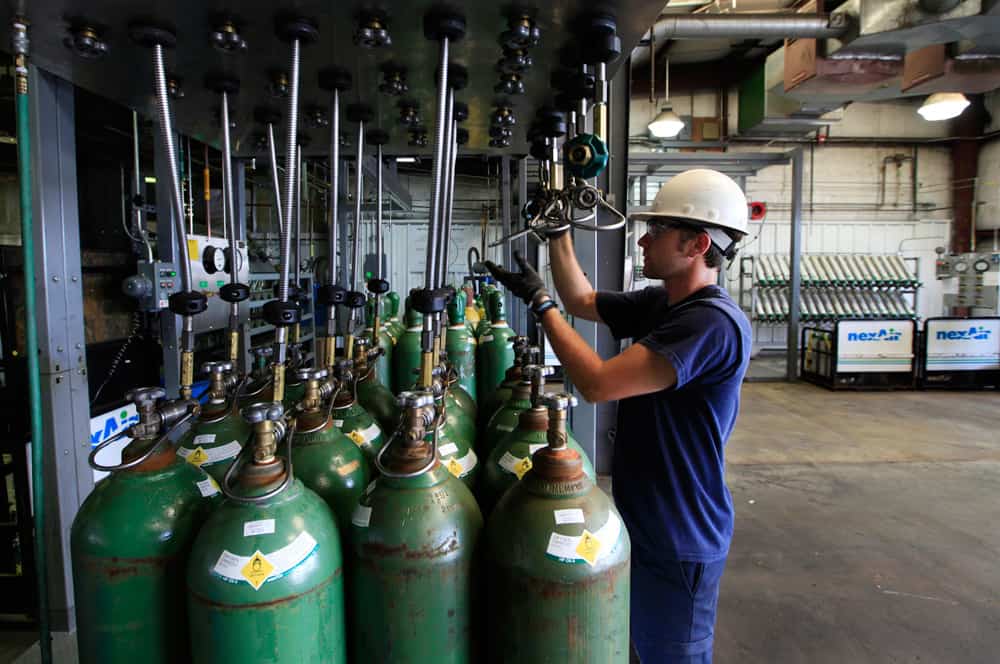
Manual welders compensate for gas delivery problems without thinking about it. Pressure drops a bit and they unconsciously adjust their technique. A robot has no such ability—it executes its program regardless of what the gas system is doing. If pressure fluctuates, every part gets welded with fluctuating pressure until someone notices the problem. This means your gas delivery needs to match the precision of the robot. Pressure regulation that’s “close enough” for manual welding creates consistent defects in automated production. Gas mixtures that vary by a few percentage points produce welds with different mechanical properties.
We help fabricators upgrade their gas systems to support automation. Tighter pressure control, more precise gas mixing, better monitoring—the infrastructure needs to deliver consistency that matches what the robot provides. That’s where nexAir’s expert KnowHow™ makes the difference between automation that works reliably and automation that creates new headaches.
Programming Time Is Your Real Constraint
The actual welding is fast once you’ve programmed the robot. Getting to that point takes longer than most people expect. You’re teaching the robot every position, every movement, every parameter. Complex weldments with multiple joints in different orientations require extensive programming and testing. Smart shops batch similar parts together so programming time gets amortized across multiple products. A robot programmed for one bracket design can often handle variations with minor adjustments rather than complete reprogramming. Building this flexibility into your initial setup reduces the programming burden for future work.
Welding automation works when you match it to the right applications and support it with proper infrastructure. Talk to nexAir about your production volumes and we’ll help you figure out whether automation makes sense and what gas systems you need to support it. We help shops Forge Forward with automation that improves margins instead of just sounding impressive. Get in touch and let’s look at your specific situation.


Don't see what you're looking for?
Everything we offer is a click away and it will arrive before you know it.