Key Considerations When Designing Medical Gas Systems
Medical gas systems are among the most consequential infrastructure decisions a healthcare facility makes. The piping, valves, alarms, and supply sources that deliver oxygen, medical air, nitrous oxide, and vacuum to patient care areas must function reliably around the clock. Getting the design right from the start prevents costly modifications later and, more critically, protects patients whose care depends on uninterrupted gas delivery.
Risk-Based Design Under NFPA 99
NFPA 99, the Health Care Facilities Code, governs medical gas system design across the United States and is required for CMS and Joint Commission compliance. The code uses a risk-based framework that assigns systems to categories based on how a failure would affect patient outcomes. A failure in an operating room or intensive care unit could be immediately life-threatening, which drives more stringent design requirements than spaces where gas system failures carry lower clinical risk.
The risk assessment process determines category assignments, informs source equipment sizing, and shapes redundancy requirements across the system. It is a required component of NFPA 99 compliance, not a discretionary step, and should happen early in the design process before architectural and mechanical decisions get locked in.
Piping Materials and Cross-Connection Prevention
NFPA 99 specifies Type K or Type L copper tubing as the standard for medical gas piping. Certain listed corrugated stainless steel tubing systems may be permitted in specific applications, though copper remains the predominant material in most installations.
Cross-connection prevention is one of the most critical requirements. A cross-connection, where different gas systems become mixed in the distribution network, poses a direct patient safety risk. Before a system is commissioned, each outlet and inlet must be tested to verify that no cross-connections exist between separate gas and vacuum systems. This testing is required by code and must be completed before the system goes into service.
Redundancy and Alarm Requirements
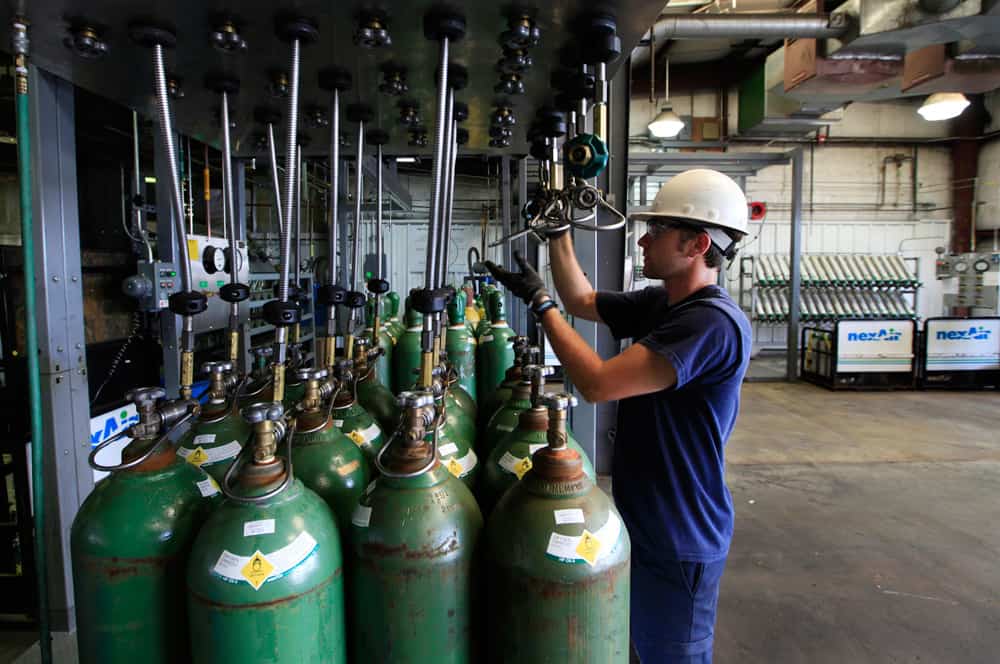
Category 1 systems require redundancy built into source equipment and distribution design so that a single failure does not interrupt gas delivery to critical care areas. In practice, this typically means dual manifold banks with automatic switchover and piping configurations that allow portions of the system to be isolated without cutting off gas to active patient areas.
NFPA 99 requires specific alarm types for medical gas systems, including master alarms, area alarms, and source alarms, with placement and monitoring requirements that vary by system type and category. These alarms monitor pressure conditions and equipment status, and their proper design and placement is a code requirement, not an optional feature. An Emergency Oxygen Supply Connection is required for Category 1 central supply oxygen systems, providing an exterior inlet where a temporary supply source can connect to the facility’s pipeline if the primary source goes offline.
Storage and Facility Planning
Medical gas storage has its own set of requirements under NFPA 99 and is a frequent area of non-compliance during inspections. Storage rooms require adequate ventilation, and specific requirements depend on the gases stored and the type of room. Oxidizing gases must be stored away from flammable materials, and signage requirements are detailed and specific. Equipment such as compressors, vacuum pumps, and manifolds must be connected to the facility’s essential electrical system, though that requirement applies to the equipment itself rather than the storage room.
These requirements apply from the initial design phase. Repurposing an existing room for medical gas storage after the fact almost always results in gaps that require correction. Facilities planning new construction or renovations benefit from involving medical gas system expertise early, when design decisions are still flexible.
nexAir’s KnowHow™ supports healthcare facilities with medical gas supply, installation, monitoring, and compliance guidance, helping ensure gas delivery systems operate safely and reliably. Connect with nexAir today and Forge Forward with a partner that brings technical depth to one of your facility’s most critical systems.
Looking out for your future
Get your career going on the right track with nexAir
Find out how nexAir KnowHow has impacted businesses all over the Southeast
Our expertise makes us more than a valuable partner, it makes us headlines

Don't see what you're looking for?
Everything we offer is a click away and it will arrive before you know it.