
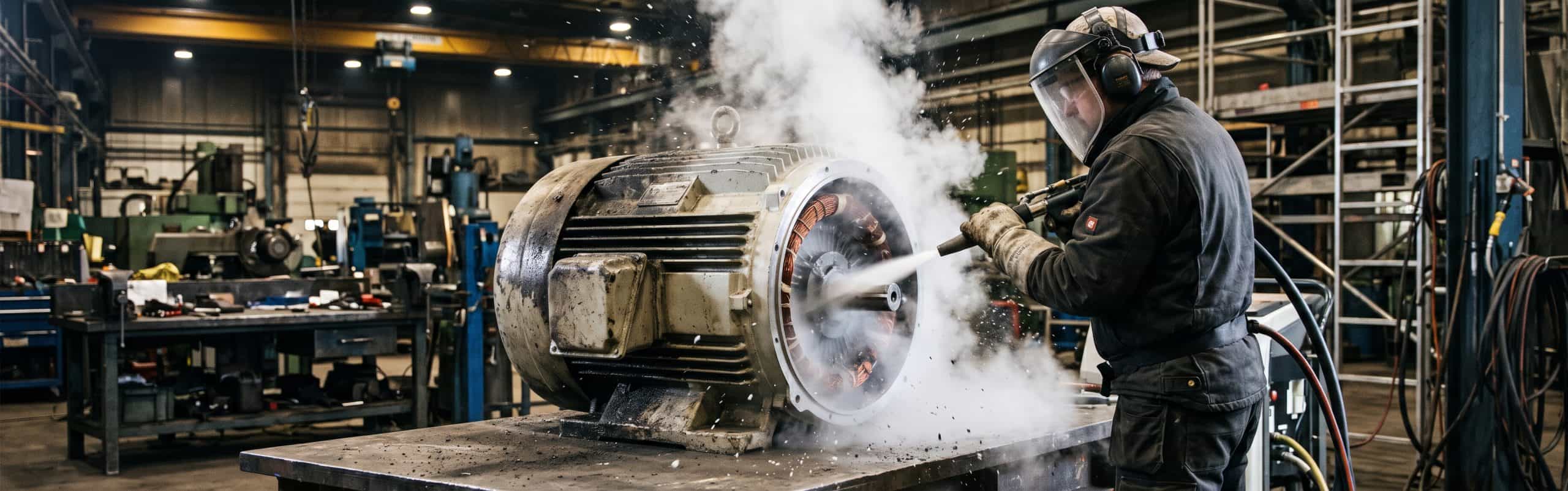
How Can I Remove Carbon Buildup From Electric Motors Without Moisture Damage?
Dry ice blasting removes soot and buildup from motors without moisture: solid CO2 pellets sublimate on impact, leaving no liquid or residue. Compressed air drives the pellets at the surface, and nexAir describes the process as non-abrasive and non-conductive, so motors can be cleaned in place without water, solvents or disassembly.
How Dry Ice Blasting Cleans Motors Without Moisture
- Compressed air accelerates solid CO2 pellets toward the contaminated surface.
- On impact the pellets sublimate, turning directly from solid to gas, so no liquid or residue remains.
- Kinetic energy and rapid temperature change break the bond between contaminants and the surface, removing dirt, grease, soot and buildup without abrasive contact.
- nexAir describes the process as non-conductive, and says that makes it safe for live electrical components and circuit boards.
- No blasting media remains, so there is no secondary waste to collect or dispose of.
Cleaning Methods Compared for Motors and Electrical Components
This comparison uses only what the nexAir page states. Cells marked "Not stated on the page" are left open on purpose.
| Method | Moisture and residue | Surface and tolerance impact | Downtime and disassembly | Source |
|---|---|---|---|---|
| Water-based cleaning | Leaves moisture behind; water is unsuitable for most electrical work | Not stated on the page | Not stated on the page | nexAir |
| Chemical solvents | Can corrode and leave residue; can cause conductivity problems | Not stated on the page | Not stated on the page | nexAir |
| Abrasive blasting and manual scrubbing | Not stated on the page | Abrasives scratch surfaces and change dimensions | Scrubbing takes equipment offline and risks reassembly errors | nexAir |
| Dry ice blasting | Pellets sublimate; no liquid or residue; no secondary waste | Non-abrasive; no etching and no change to dimensional tolerances | Cleans in place, without disassembly and often without going offline | nexAir |
Why Buildup on Motors Needs Regular Removal
- Circuit boards, control panels, motors and wiring have tight tolerances and easily damaged parts.
- Contaminant buildup on motors and electrical components restricts heat dissipation, which accelerates wear and raises failure risk.
- A consistent cleaning schedule keeps components cooler and closer to spec, which means fewer repair events and longer service life.
- Cleaning in place removes disassembly time, so facilities with tight maintenance windows can bring equipment back online sooner.
Dry Ice Quality Affects Results
nexAir states that results depend on dry ice quality. Inconsistent pellet density or moisture contamination in the dry ice changes how the media performs on contact. nexAir says it produces and supplies dry ice built for consistent results and can help match an approach to specific equipment.
Standards and Best Practices
These points come from OSHA documents, not from the nexAir page. They are general safety references. Confirm how they apply to your site with your safety lead.
- OSHA's bulletin on CO2 supply systems states that carbon dioxide displaces oxygen and is colorless, odorless and denser than air, so it can collect in below-grade areas. It advises ventilating enclosed or below-grade areas. Blasting turns pellets into CO2 gas, which makes this guidance relevant to enclosed motor rooms. [1]
- OSHA's hazard alert on CO2 and liquid nitrogen releases names oxygen detectors, emergency ventilation and worker training as essential safeguards. That alert addresses flash-freezing processes, and it is cited here for its CO2 precautions. [3]
- OSHA's lockout/tagout standard requires equipment to be isolated from its energy source and made inoperative before servicing or maintenance where unexpected energization could cause injury. The standard also lists scope exclusions, including electrical work covered by Subpart S. [2]
The nexAir page describes dry ice blasting as safe for live electrical components. OSHA's lockout/tagout standard separately requires energy isolation where its scope applies. These two statements come from different sources and are not reconciled here.
Frequently Asked Questions
Can dry ice blasting clean an electric motor without water?
Yes, according to nexAir. The pellets are solid CO2 that sublimate on impact, going directly from solid to gas, so no liquid or residue is left behind. nexAir describes water as unsuitable for most electrical applications.
Will dry ice blasting scratch or change the dimensions of motor surfaces?
nexAir describes the cleaning as non-abrasive. It says kinetic energy and rapid temperature change break the bond between contaminants and the surface, so motors, circuit boards, switchgear and control systems are cleaned without etching surfaces or changing dimensional tolerances.
Why does soot and buildup on a motor matter?
nexAir says contaminant buildup on motors and electrical components restricts heat dissipation, which accelerates wear and raises failure risk. Cleaning on a consistent schedule keeps components cooler, closer to spec and less prone to repairs.
Do I have to disassemble the motor to clean it?
No, according to nexAir. Equipment can be cleaned in place without disassembly and often without being taken offline, which removes disassembly time and the risk of reassembly errors. Power isolation requirements are a separate safety question, covered in the standards and best practices section.
References
- OSHA, HIB 06-05-96, Potential Carbon Dioxide (CO2) Asphyxiation Hazard When Filling Stationary Low Pressure CO2 Supply Systems, 1996.
- OSHA, 29 CFR 1910.147, The control of hazardous energy (lockout/tagout).
- OSHA, HA-4450, Hazards Associated with the Release of Liquid Nitrogen and Carbon Dioxide During Flash Freezing Processes, October 2024.
Read the full guide: Dry Ice Blasting for Sensitive Equipment and Electronics